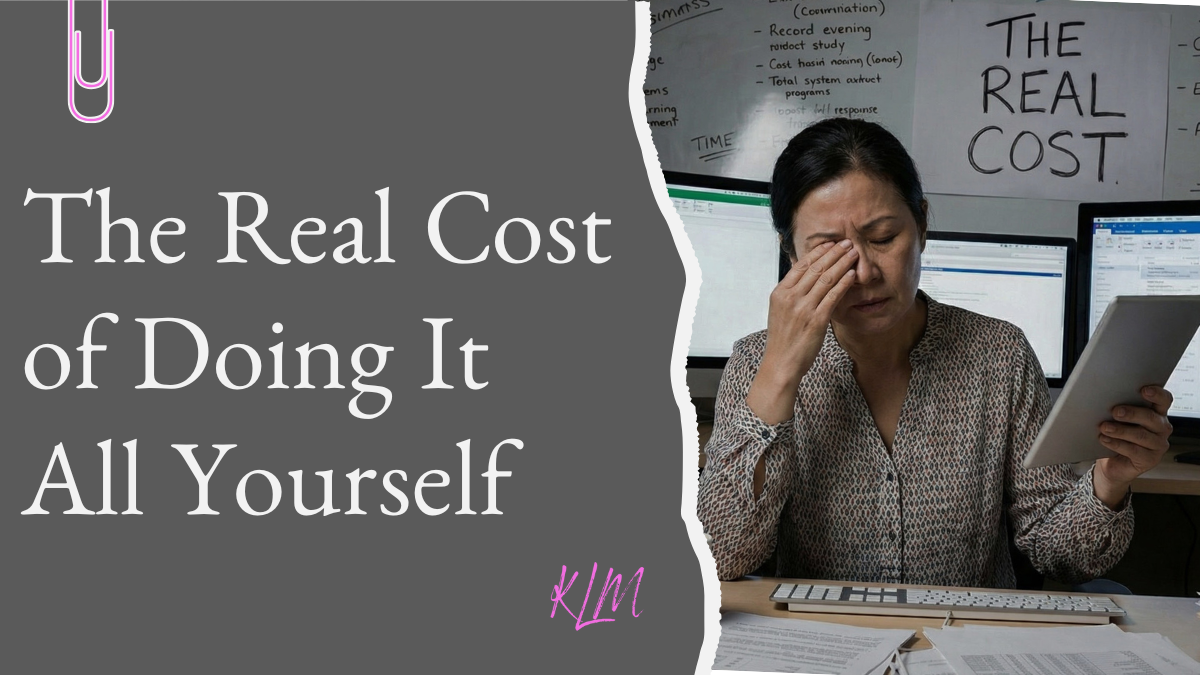
The Real Cost of Doing It All Yourself
Most successful founders do not get stuck because they lack ideas, talent, or opportunity. They get stuck because their attention becomes the bottleneck. When your business is doing $500K to $20M a year, you are not trying to “work harder.” You are trying to build a business that can grow without requiring your nervous system as the operating system.
And here’s the quiet risk nobody likes to talk about: if you keep being the person who catches every falling plate, eventually you either burn out…or you break something important. Sometimes that “something” is your health. Sometimes it’s your marriage. Sometimes it’s your team culture. Sometimes it’s the business itself.
Plenty of thriving companies have shut down, sold too early, or stalled out; not because the market dried up, but because the owner ran out of capacity. 50% of small businesses don’t make it past year 5. So let’s make this educational and practical: what is actually happening when you do it all yourself, why it is so expensive, and what to put in place before you hit the wall.
The Growth Trap: “Everything Is Going Well… So Why Does It Feel Worse?”
Early on, hustle works. You can keep processes in your head. You can answer questions fast. You can patch gaps with effort. But growth changes the physics of your business.
More clients means more communication, more coordination, more follow up, and more opportunity for mistakes. When you have more team members, it means more training, more management, more handoffs, and more room for misalignment. When you are doing more marketing, it means more leads and more responsibility to respond quickly and consistently. That marketing turns into more projects and work to be done, which means more timelines, more vendors, more decisions, more moving parts.
At a certain point, your business stops being a simple machine and becomes a complex system. And complex systems do not scale on memory, heroics, and “just one more late night.” They scale on clear ownership, repeatable processes, systems and support that can execute. If you are feeling stretched while the numbers look fine, that is not a character flaw. It is a sign that your business has outgrown your current structure.
The True Cost You Cannot See on a P&L: Owner Attention
When owners look at costs, they usually focus on what is easy to measure: payroll, software, contractors, marketing spend, rent. But one of the most expensive things in your business is not on your profit and loss statement. It is the owner’s divided attention.
Every time you say, “I’ll just handle it,” you are trading the part of your brain that should be doing CEO work, which is strategy, partnerships, high value sales, and long term planning, for work that could be delegated, automated, or owned by someone else with the right system. A few times does not matter.
But repeated over months and years, it creates a predictable pattern:
- strategic projects stall
- your calendar becomes reactive
- your team waits on you for decisions
- growth becomes harder even though demand is strong
This is why you can be successful on paper and exhausted in real life.
The Burnout Timeline: What Happens When You Wait Too Long
Burnout rarely happens all at once. It usually follows a slow arc:
- You start doing more “temporarily.” You step into gaps, cover roles, and keep things moving because you care.
- Temporarily becomes normal. Your team gets used to you being the safety net. You become the default.
- Your brain is always “on.” Even when you are off, you are thinking about what is slipping.
- You start losing your edge. You feel more scattered. More forgetful. More frustrated. Less patient. Less creative.
- Something forces a change. It could be health issues, a major client problem, a team member quits, a family emergency. Or it could be that the business hits a ceiling or the idea of continuing starts to feel heavy.
The scary part is that you often do not realize you are on this timeline until you are far down it. The good news is that burnout is not inevitable. But it does require one thing: getting out of your own way early enough to build capacity before you “need” it.
The Three Levers That Create Capacity: Delegate, Automate, Outsource
Most business owners know these words. The difference is knowing how to apply them strategically. Delegation means your employees own defined outcomes, not just random tasks. Automation means repeated steps happen reliably without you (and without relying on someone’s memory). This is easy with AI. Outsourcing means you bring in experienced support for work that is critical but not worth building as full time staff yet.
These are not “productivity hacks.” They create business infrastructure. They prevent the founder from becoming the choke point. The smartest owners we know do not ask, “Can I do this myself?” They ask, “Who can I hire to do this”
Why Delegation Fails (and How to Fix It)
If you have tried delegating and it made things worse, you are not alone. It usually fails for one of three reasons:
- The task is unclear. “Help with operations” is vague. Vague tasks create vague results.
- Ownership is missing. If no one owns the outcome, everything comes back to the founder.
- The support level is mismatched. Some work needs a doer. Some needs a project manager. Some needs an operator who can think like an owner.
When you delegate without clarity, ownership, and the right level of brainpower, you end up managing helpers instead of getting relief. That is why founders often say, “It’s easier to just do it myself.” It feels easier until it costs you your health, your family time, or your ability to grow.
The “Outsourcing Sweet Spot” for $500K to $20M Businesses
There is a very real stage where outsourcing becomes the smartest move financially and operationally. If you are growing and you need:
- systems built
- processes documented
- marketing executed consistently
- projects managed end to end
- hiring pipelines and onboarding created
- tech and CRM organized
- follow up and automations implemented
…but you do not want to hire multiple full time roles to cover all of that, a fractional team like KLM can make a lot of sense. It is often the bridge between “the owner is holding everything” and “we have a full internal leadership team.” In other words: outsourced support is how you build the structure that allows growth without chaos.
A Practical Self-Check: Signs You Need to Get Out of Your Own Way
If you want a quick reality check, here are a few common signals:
- Your business depends on you answering questions all day.
- Key projects keep getting pushed to “next quarter.”
- Your team is capable but constantly asking for direction.
- You have software tools but no one is really managing them.
- You keep saying, “Once I get through this season…”
- Your brain feels full even when you are not working.
- You are making good money but you feel trapped by the business.
None of these mean you are doing anything wrong. They mean you have reached the point where willpower is no longer the solution.
What to Do Next: Build a Simple Capacity Plan
Instead of trying to fix everything at once, start here:
- Make a list of what is taking up your time and mental space. Projects, decisions, recurring tasks, things you keep avoiding, the “I’ll get to it” list.
- Sort it by impact. What moves revenue, profit, risk reduction, or meaningful relief in the next 30 to 90 days?
- Decide the right lane for each item. Delegate to your team, automate it, outsource it, or eliminate it.
- Assign real ownership and deadlines. If it matters, someone has to own it and it has to have a finish line.
This is exactly the kind of exercise we walk owners through at KLM because most founders do not need more ideas. Instead, they need a clear plan, clean delegation, and an implementation team like ours that can actually execute.
The Goal Is Not to Do Less. The Goal Is to Lead Better.
Getting out of your own way is not about being “hands off.” It is about protecting the one resource your business cannot replace: you. If you are already successful, you do not need to prove you can carry it all. You already did that. The next stage is building a business that does not require you to be the safety net for everything.
Delegation, automation, and outsourcing are how you create a company that can grow without burning down the person who built it. And if you are reading this with that familiar “this is me” feeling, take it as a friendly nudge. Do not wait until your body, your family, or your calendar forces the change. Build capacity while you still have energy. That is how you scale sustainably.
If you want help turning your overloaded mental list into a clear 30/60/90 day plan and handing off the right pieces to a fractional team who can plug in quickly, KLM is built for that stage of business. Book a free consult to learn more about our team and how we can help you HERE.